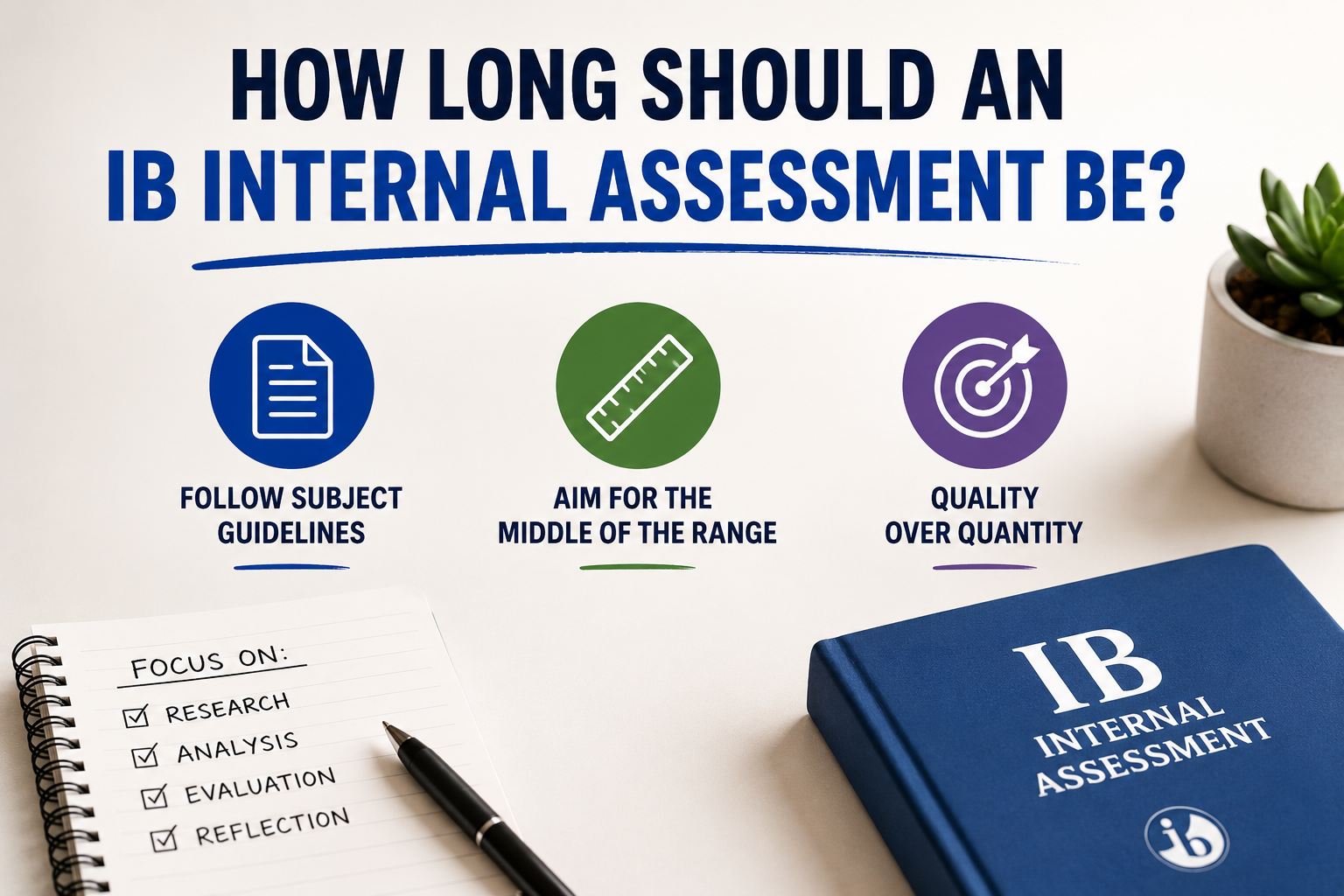
Every IB subject has a different word count or page limit for its Internal Assessment, and these limits are not suggestions — going significantly over often means examiners simply stop reading (and grading) at the cutoff, while going significantly under usually signals underdeveloped analysis. Because these limits are periodically updated by the IB, always confirm the current figure in your subject guide or with your teacher before finalizing your IA — but the general ranges below reflect what most current guides specify.
Typical Length Guidelines by Subject Group
Group 4 Sciences (Biology, Chemistry, Physics): Generally around 6-12 pages including graphs, tables, and images, though some subject guides specify a word count instead of or alongside a page limit. The emphasis is less on hitting an exact number and more on being concise — dense, focused writing with clear data presentation typically outperforms longer reports padded with repeated explanation.
Mathematics (AA and AI): Typically 12-20 pages for the exploration, including diagrams and calculations. Explorations significantly longer than this are usually a sign that background explanation or repetitive calculator output has crept in, rather than a sign of thoroughness.
Economics: Three commentaries, each around 800 words (excluding diagrams, references, and the appendix/article). This is one of the strictest word-count rules in the Diploma Programme — examiners typically stop reading and assessing content beyond the limit.
Business Management: Generally in the 1,800-2,200 word range for the written IA, depending on the current subject guide.
Psychology: Typically around 1,800-2,200 words for the written report, excluding the raw data, references, and appendices.
English A (Individual Oral): Not a word count but a strict time limit — a 10-minute presentation followed by roughly 5 minutes of discussion, so the «length» constraint here is about pacing your spoken delivery rather than counting words.
Extended Essay (for comparison): Often confused with subject IAs, but this is a separate 4,000-word piece of independent research, not part of any single subject’s Internal Assessment component.
What Counts Toward the Word/Page Count
This varies by subject, but as a general pattern:
- Usually excluded: titles, headers, references/bibliography, raw data tables/appendices, diagram labels (subject-dependent)
- Usually included: all continuous prose analysis, discussion, and evaluation text
Always check your specific subject guide, since the exact rule (word count vs page count, what’s excluded) differs meaningfully between subjects and is the single most common source of confusion among students.
Why Going Over the Limit Is Riskier Than Going Under
A report that’s too short usually loses marks gradually, criterion by criterion, because there simply isn’t enough content to demonstrate the required depth. A report that goes over the limit can lose marks abruptly, because anything beyond the cutoff may not be read or assessed at all — meaning a strong concluding evaluation written in the final paragraph of an over-length report may never even be seen by the examiner.
How to Cut Words Without Losing Content
- Remove background theory your reader already knows from the syllabus — reference it briefly instead of re-explaining it in full
- Move raw data tables to an appendix rather than embedding them in your body text (subject to your subject’s specific rules)
- Cut repeated restating of your research question or hypothesis in multiple sections
- Combine sentences that separately state a result and then separately interpret it, where the two can be merged concisely
Final Tip
Write your first full draft without worrying about the word count at all — get every idea down. Then edit for length as a separate final step, cutting explanation and repetition rather than genuine analysis.