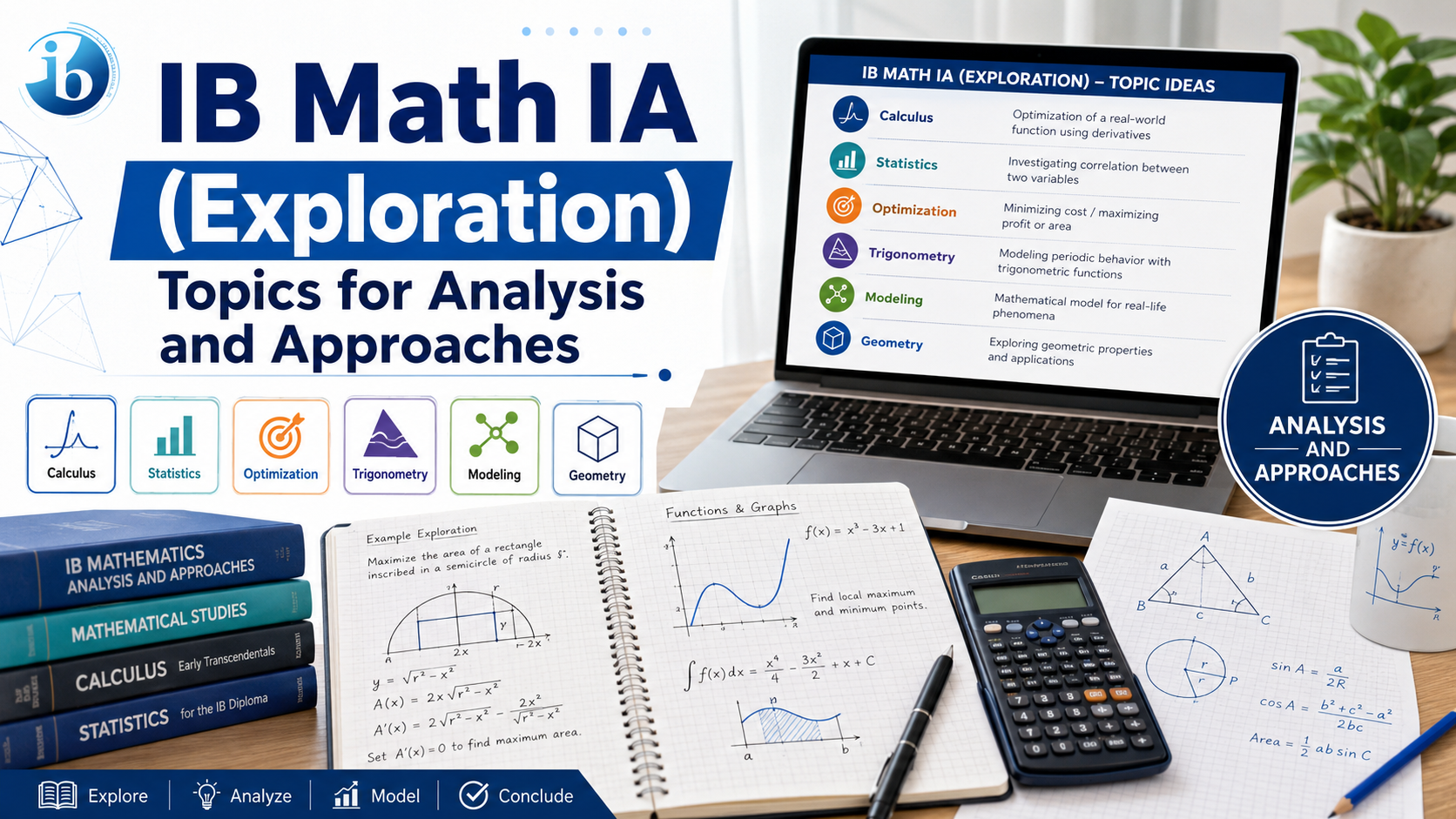
The Math AA Internal Assessment — officially called the «Exploration» — is often the most feared piece of coursework in the entire Diploma Programme, mostly because students don’t know where to start. Unlike a typical math problem, there’s no single «correct» topic; the exploration is graded on mathematical depth, personal engagement, and how well you communicate your reasoning, not just on getting a right answer.
What Makes a Math AA Topic Strong
A strong topic:
- Connects to a genuine personal interest (sport, music, a game, an app you use, another subject you study)
- Goes beyond the syllabus in at least one area, showing extension
- Allows you to demonstrate a clear mathematical process, not just look up a formula and plug in numbers
- Has enough depth to sustain 12-20 pages of genuine mathematical exploration
15 Topic Ideas for Math AA (HL and SL)
Calculus-based:
- Modeling the trajectory of a basketball shot using projectile motion and optimizing the angle for maximum range
- Using differential equations to model the cooling rate of a cup of coffee (Newton’s Law of Cooling) and comparing to real data
- Optimizing the dimensions of a can or package to minimize material use for a fixed volume
- Modeling population growth of a species using logistic growth equations and comparing to real data
Statistics-based: 5. Investigating correlation between two variables in a sport you play (e.g., serve speed vs win rate in tennis) 6. Using regression analysis to model and predict housing prices in a specific market 7. Testing whether a specific game (dice, cards) truly has the probabilities it claims, using chi-squared analysis on real trial data
Geometry & Trigonometry-based: 8. Modeling the geometry of a musical instrument (e.g., how string length relates to pitch on a guitar) using trigonometric or exponential functions 9. Investigating the mathematics behind camera lens distortion or perspective drawing 10. Exploring the geometry and area-efficiency of tiling/tessellation patterns
Number Theory & Algebra-based (mostly HL): 11. Investigating patterns in prime number distribution using the Sieve of Eratosthenes and comparing to the Prime Number Theorem 12. Exploring Fibonacci sequences and the golden ratio in natural growth patterns 13. Investigating matrix transformations and their applications in computer graphics
Real-World Modeling: 14. Modeling the spread of a piece of information or a disease using exponential and logistic models 15. Using calculus to optimize a real financial decision (e.g., loan repayment, compound interest strategy)
HL vs SL: Adjusting the Depth
The topic itself can be identical for HL and SL students — what differs is the depth of the mathematics you apply. An HL student modeling projectile motion might incorporate air resistance using a differential equation, while an SL student might focus on the simpler constant-acceleration model but analyze it more thoroughly with clear, well-explained working.
Common Mistakes That Lower the Score
- Choosing a topic that only requires syllabus-level math with no extension
- Copying a «worked example» style investigation with no personal data or original angle
- Including long stretches of technology-generated output (like unexplained calculator/software screenshots) without walking through the reasoning
- Weak or missing reflection — simply stating «this was interesting» instead of critically discussing the limitations of the model
Final Tip
Start by writing down 3-5 things you’re genuinely interested in — sports, hobbies, other subjects — before you think about math at all. The strongest explorations almost always start from real curiosity, not from searching «IA topic ideas» the night before the deadline.