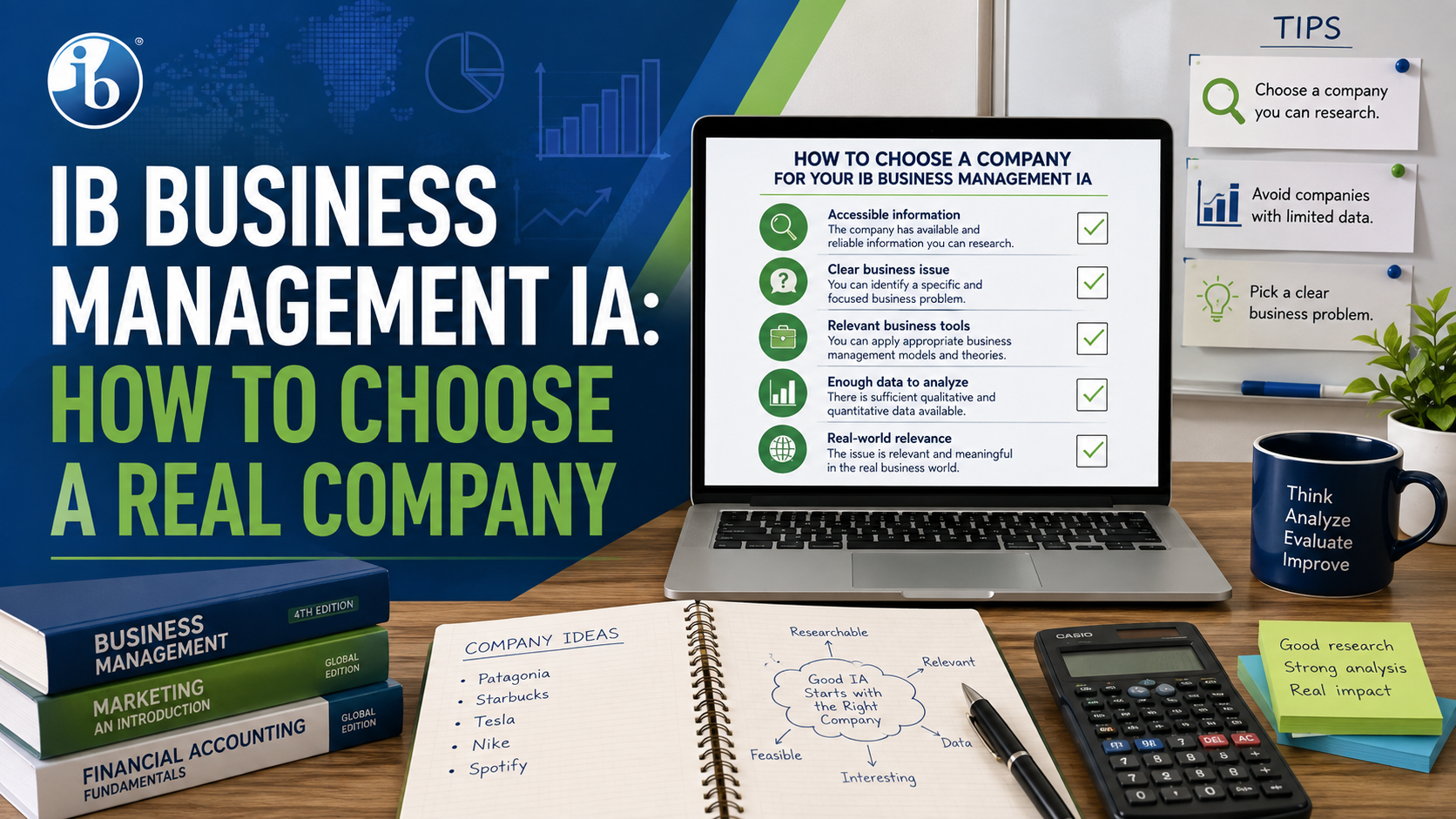
The Business Management Internal Assessment requires you to investigate a real issue or problem facing a real organization, using at least three appropriate tools of business analysis. Before you can apply a single tool or theory, though, you need to choose the right organization — and this single decision determines how easy (or painful) the rest of the IA will be.
What «Real Organization» Actually Means
The organization can be a business, a not-for-profit, or a social enterprise — but it must be a genuine, identifiable entity, not a hypothetical case study. Crucially, it needs to be an organization you can realistically get information about: through interviews, its own published reports, local news coverage, or direct observation.
The Three Best Types of Organizations to Choose
- A small local business you have personal access to — a family business, a business owned by someone you know, or a local shop/restaurant where the owner is willing to be interviewed. This is usually the strongest option because you can get first-hand qualitative data (interviews, direct observation of operations) that most students simply can’t access for a large multinational.
- A larger, well-documented company facing a clearly reported issue — a company that has been in the news for a specific, analyzable problem (an expansion decision, a restructuring, a marketing failure). This works well if you don’t have access to a small business, but you must rely entirely on secondary sources, so the issue needs to be well covered in reliable business media.
- A social enterprise or NGO — often overlooked, but these organizations frequently face rich, analyzable issues (funding models, stakeholder conflict, scaling decisions) and are sometimes more willing to grant a student interview than a large corporation.
Why Small Local Businesses Usually Score Higher
Access to primary data is one of the strongest ways to demonstrate personal engagement and produce genuinely original analysis, rather than analysis that echoes what a journalist already concluded. An interview with a real business owner about a real decision they’re facing gives you unique data no other student in the world will have — which is exactly what separates a high-scoring IA from a generic one.
How to Identify a Strong «Issue or Problem»
Once you’ve picked an organization, the issue itself needs to meet a few criteria:
- It must be specific and current — not a vague, general challenge like «increasing competition.»
- It must be genuinely analyzable using business tools (SWOT, Ansoff Matrix, decision trees, ratio analysis, STEEPLE, etc.) — avoid issues that are purely a matter of opinion with no quantifiable or structured way to assess them.
- There should be a real decision or recommendation you can make at the end — the IA should build toward a justified, evidence-based conclusion, not just a description of the problem.
Common Mistakes When Choosing an Organization
- Picking a huge, famous multinational with no real access to specific internal data, forcing reliance on generic, widely available information
- Choosing an issue that’s already been resolved with no ambiguity, leaving no real room for your own recommendation
- Failing to confirm early on whether the organization or owner is actually willing to answer questions — leaving you stuck with only secondary sources close to the deadline
Final Tip
Reach out to potential organizations weeks — not days — before your first draft is due. The strongest Business Management IAs are almost always built around at least one real interview, and arranging that takes time.